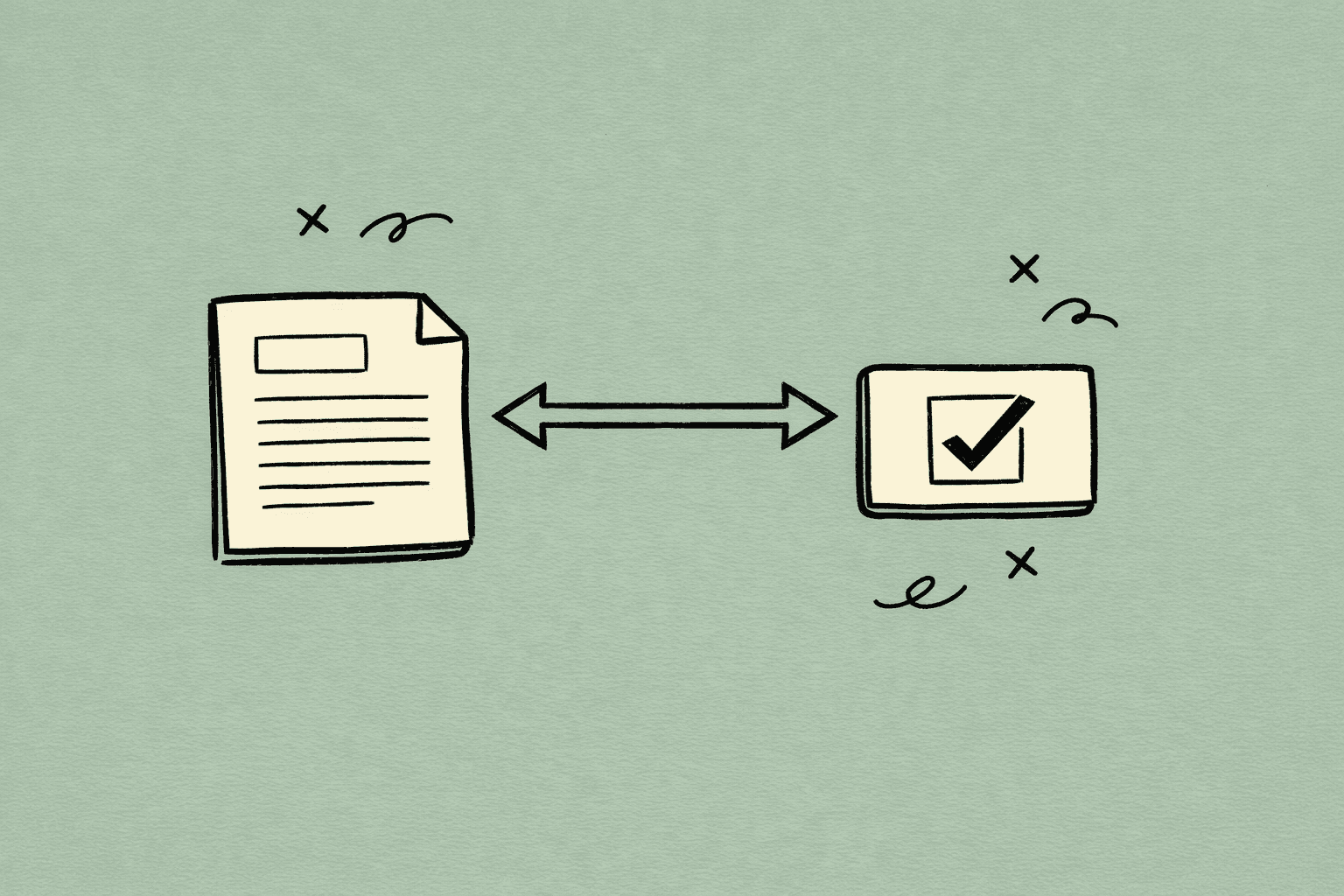
Coverage IntelligenceClaim Scrubbing
Coverage Intelligence vs. Claim Scrubbing
A clean claim still has to answer the coverage question.
Why a clean claim can still be a coverage risk
Most revenue-cycle systems treat claim quality as something that can be checked near the end of the workflow. In one sense, that is right. A claim should be checked before it is submitted. If required fields are missing, codes are invalid, modifiers are unsupported, units are wrong, or claim lines conflict with standard edits, the claim should not go out.
But claim correctness is not the same as coverage correctness.
A claim scrubber can usually tell a team whether a claim appears structurally valid. It is much less likely to tell them whether the payer's policy supports the service, whether prior authorization was required, whether the diagnosis context is sufficient, whether the site of service changes the rule, or whether the documentation packet contains the evidence the payer will need.
That distinction matters because many denials do not begin at submission. They begin earlier, when a team assumes that a service is covered, that an authorization is unnecessary, that a diagnosis is enough, or that the right documentation already exists.
We think this is where coverage intelligence belongs: before submission, and often before the claim is created at all.
Claim scrubbing checks the claim
A claim scrubber operates on the claim artifact. It checks the structured transaction that will be sent to the payer or clearinghouse. That work is necessary because claims have to conform to standardized administrative formats. CMS lists ASC X12N 837 Version 5010 as the adopted HIPAA transaction standard for institutional, professional, and dental health claims.1
In practice, claim scrubbing is good at catching problems that are visible from the claim itself. The code may be invalid. The modifier may not fit. A required field may be absent. Two services may be billed together when they should not be. The number of units may exceed an expected limit. The same service line may appear twice.
Medicare's National Correct Coding Initiative is one example of this type of logic. CMS says NCCI Procedure-to-Procedure edits are used to prevent improper payment when incorrect code combinations are reported. CMS also describes Medically Unlikely Edits as a way to prevent improper payment when incorrect units of service are reported.2
That is useful. It catches concrete errors that would otherwise create rejections, denials, rework, or delayed payment.
But it is limited by what it sees.
The claim is a transaction. It is not the full clinical, policy, authorization, and documentation context around the service.
Coverage intelligence checks the policy context
Coverage intelligence starts from a different premise. The relevant question is not only whether the claim can be submitted. It is whether the service is supported by payer policy in the context where it is being billed.
That context can include the payer, plan, state, procedure code, diagnosis, modifier, site of service, policy source, effective date, prior-authorization rule, and documentation requirement. Backwork describes Verity as a system that turns payer policies into source-backed coverage decisions, validation APIs, agent-safe tools, and policy-change alerts for prior authorization and denial prevention.3
The difference is not cosmetic. Claim scrubbing validates the claim object. Coverage intelligence validates the rule environment around the claim.
A coverage system needs to answer questions that a claim scrubber may not be designed to answer. It should identify whether prior authorization is required, whether the diagnosis supports coverage, whether the site of service changes the rule, whether the payer requires chart notes or imaging or lab values, whether the policy was effective on the date of service, and which source supports the answer.
This is not a replacement for claim scrubbing. It is a different layer.
The failure mode is easy to miss
Consider a service that passes basic claim edits.
The CPT code is valid. The ICD-10 code is formatted correctly. The provider identifier is present. The modifier is accepted. The units do not exceed the edit threshold. The payer accepts the transaction. The service line is not an obvious duplicate.
The claim appears clean.
But the payer policy may still say that the service required prior authorization. It may say the diagnosis must match a narrower medical-necessity list. It may require conservative therapy first. It may require imaging, lab evidence, or clinical notes. It may treat the same procedure differently depending on whether it was performed in an office, ASC, hospital outpatient department, inpatient setting, home, or DME context. It may have changed after the team last checked it.
In that situation, the scrubber did not fail. It answered the question it was designed to answer.
The problem is that the team asked it a coverage question.
Some payment risk lives outside the claim
This is why the distinction persists even as claims infrastructure improves.
HHS's 2026 claims-attachments final rule is a useful signal. The Federal Register explains that HHS adopted standards only for health care claims attachments transactions or equivalent encounter transactions, which support health care claims transactions. The rule exists because payers often need supporting information beyond the claim transaction itself.4
That matters operationally. A claim can be valid and still lack the evidence needed to justify payment. The payer's decision may depend on clinical notes, imaging, diagnostic results, prior treatment history, or other documentation that does not fit cleanly into ordinary claim fields.
Prior authorization has the same problem. CAQH reported that only 35% of prior authorizations were processed electronically in the 2024 CAQH Index, and that only 9% of surveyed organizations could support the electronic prior-authorization API required for 2027 under a CMS rule.5
CMS has finalized prior-authorization interoperability requirements for impacted payers, including API requirements intended to improve transparency and process automation.6
Those requirements may improve the transaction layer. They do not, by themselves, make payer policy easy to interpret, monitor, or apply at the point of work.
An API can move a request. It does not automatically explain the rule.
The distinction
The distinction is simple enough, but it has large workflow consequences.
Claim scrubbing asks whether the claim is structurally and coding-wise submit-ready.
Coverage intelligence asks whether the service is defensible under payer policy.
The first question is mostly about the transaction. The second is about the service, the payer rule, and the evidence needed to support payment.
Both questions matter. They should not be collapsed into one system.
Where the workflow should change
Many teams check coverage too late.
They discover authorization requirements after the service has already moved through scheduling. They collect documentation after the payer asks for it. They review policy after the claim exists. They find missing evidence after the denial has already been created.
That order is backwards.
A safer workflow begins with the coverage question. The system should identify the policy source, determine whether prior authorization is required, validate the diagnosis and site-of-service context, surface documentation requirements, resolve missing evidence, and only then move into claim creation, claim scrubbing, and submission.
This does not remove the scrubber. It gives the scrubber a better claim to inspect.
The practical implication is that coverage checking should not be treated as a final edit. It should be treated as a pre-submission risk control.
What this means for RCM vendors
RCM vendors should be careful not to treat every validation problem as a claim-editing problem.
Some checks belong at the claim line. Others belong earlier, when the system still has time to change the workflow, request documentation, start an authorization, or route the case for review.
This is especially important for products that want to support prior authorization, denial prevention, or AI agents in revenue-cycle workflows. An agent that can validate or submit claims without understanding payer-policy evidence may move faster while still missing the rule that determines whether the claim is defensible.
Backwork positions Verity as this policy layer. The product page describes pre-submission validation for code and policy combinations, including prior-auth requirements, documentation criteria, denial risk, and manual-review cases without PHI. It also describes policy monitoring for codes, payers, specialties, and policy documents, including what changed, which codes are affected, the source link, and the effective date.3
The useful output is not just a pass or fail. The useful output is a coverage position, a prior-authorization requirement, the documentation criteria, the diagnosis or site-of-service limits, the source policy, the effective date, the last verified date, and any known gaps that should send the case to manual review.
That is a different object than a claim edit.
Limitations
Coverage intelligence should not be presented as a perfect substitute for payer adjudication.
Policies can be ambiguous. Plan documents can conflict. Payer portals and PDFs can change. Medical-necessity criteria may depend on clinical facts that are missing, incomplete, or not safe to infer. Some cases should be routed to a human reviewer.
This is why source evidence matters. A coverage answer without a source is hard to audit. A confidence signal without known gaps can create false certainty. A workflow that hides uncertainty may be worse than a manual process, because it can move teams quickly in the wrong direction.
The goal should be narrower and more useful: catch policy risk earlier, show the evidence, identify missing requirements, and route uncertain cases before the claim becomes a denial.
Final implication
Claim scrubbers are still necessary. They catch real errors.
But they are not coverage systems.
The mistake is assuming that a clean claim is a safe claim. In many workflows, the more important question appears earlier: whether the service is covered, whether authorization is required, and whether the evidence exists before submission.
Coverage intelligence makes that question explicit.
For teams building RCM software, prior-auth workflows, denial-prevention systems, or healthcare agents, this should be a separate layer in the stack: source-backed, policy-aware, and close enough to the point of work to change the outcome before the payer does.
Footnotes
-
Backwork. "Coverage Intelligence for Prior Auth and Denial Prevention." backworkai.com ↩ ↩2
-
Federal Register (2026-03-24). "Administrative Simplification; Adoption of Standards for Health Care Claims Attachments Transactions." federalregister.gov ↩
-
CAQH. "The Path Forward for Prior Authorization Reform." caqh.org ↩
-
CMS. "CMS Interoperability and Prior Authorization Final Rule (CMS-0057-F)." cms.gov ↩